
Artisanal Mining and the Education Crisis Among Children: Lessons from Uganda
Artisanal and Small-Scale Mining (ASM) provides a livelihood for millions of families across Africa, Asia, and Latin America. Globally, more than 40 million people are directly engaged in ASM, while over 150 million people depend on the sector for their survival. Despite its economic importance, artisanal mining continues to have significant consequences for children's education and well-being.
MINING
Authors: MEC Mining and Exploration Consultancy Ltd
6/17/20262 min read
Artisanal Mining and the Education Crisis Among Children: Lessons from Uganda
Artisanal and Small-Scale Mining (ASM) provides a livelihood for millions of families across Africa, Asia, and Latin America. Globally, more than 40 million people are directly engaged in ASM, while over 150 million people depend on the sector for their survival. Despite its economic importance, artisanal mining continues to have significant consequences for children's education and well-being.
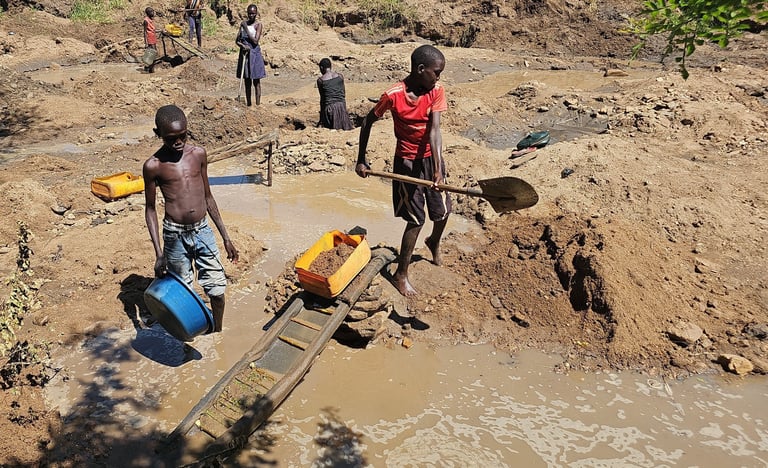
One of the most pressing concerns is child labour. The International Labour Organization estimates that more than one million children are involved in artisanal mining worldwide, performing hazardous tasks such as digging, carrying heavy loads, crushing ore, and processing minerals. These activities often interfere with school attendance, reduce academic performance, and increase school dropout rates.
In many mining communities, children are drawn into mining because of poverty and the immediate income it offers. Families struggling to meet basic needs may prioritize short-term earnings over education. Research from artisanal mining regions in Africa has shown that the expansion of mining activities can significantly reduce household investment in primary education, creating a cycle of poverty that extends across generations.
The Ugandan Experience
Uganda provides a compelling case study of the education challenges associated with artisanal mining. The country has witnessed rapid growth in artisanal gold mining, particularly in districts such as Busia, Mubende, Karamoja, and Buhweju. According to available estimates, approximately 12,000 children under the age of 14 are engaged in artisanal and small-scale gold mining activities in Uganda. These children often spend long hours digging pits, transporting ore, operating grinding machines, or washing gold-bearing sediments instead of attending school.
The consequences are far-reaching. School absenteeism, poor academic achievement, and early school dropout rates are commonly reported in mining communities. Exposure to hazardous working conditions also affects children's physical and mental development, further reducing their chances of completing formal education.
Addressing this challenge requires a combination of poverty reduction, formalization of the ASM sector, stronger enforcement of child protection laws, and investment in quality education within mining communities. Successful interventions in Uganda have demonstrated that community awareness programs, traceable mineral supply chains, and alternative livelihood opportunities can reduce child labour and improve school attendance.
Artisanal mining can contribute to rural livelihoods, but its long-term benefits will only be realized when every child in mining communities has the opportunity to remain in school and build a better future through education.
projects@mecminingug.com
+256741506843
MEC Mining and Exploration Consultancy Limited
Exploration| Mining| Resource Value Creation
Transforming Earth Data into Real Value