
Exploratory Pitting in Mineral Exploration: The Critical Bridge Between Surface Investigations and Drilling
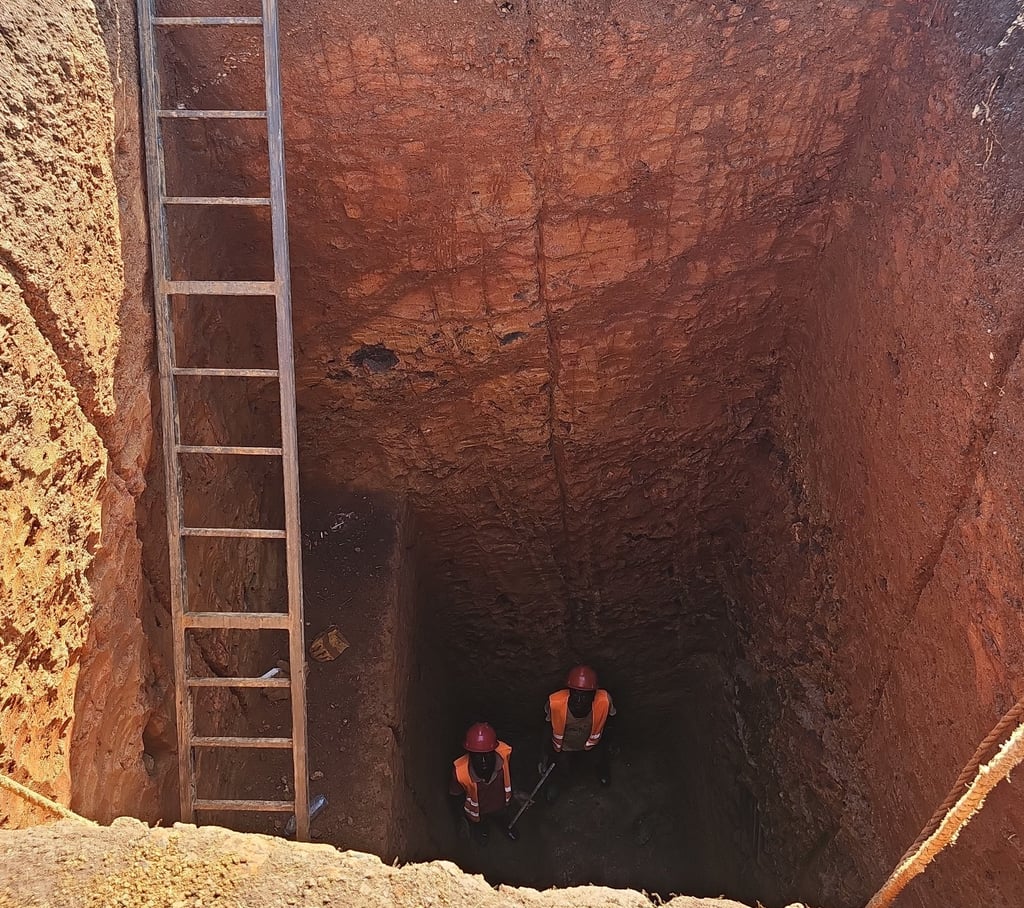
Exploratory pitting involves the excavation of shallow pits into the ground to expose fresh bedrock, weathered rock, saprolite, or mineralized horizons beneath surface soil and overburden. The pits are usually excavated manually or mechanically depending on the depth required, ground conditions, and accessibility. Pit dimensions vary according to project objectives, but commonly range from 1–3 meters in width and may extend several meters deep until fresh bedrock or target horizons are encountered. The excavated faces and floors provide geologists with direct access to geological materials that are otherwise concealed beneath vegetation, soil cover, or transported sediments. Unlike drilling, which investigates a narrow cylindrical section of the subsurface, exploratory pits expose relatively larger areas of rock, enabling detailed observation of geological features and mineralization patterns.
EXPLORATION
Authors: MEC Mining and Exploration Consultancy Limited
6/11/20265 min read
Exploratory Pitting in Mineral Exploration: The Critical Bridge Between Surface Investigations and Drilling
Introduction
Mineral exploration is a progressive process that aims to reduce geological uncertainty while increasing confidence in the presence, extent, and economic potential of a mineral deposit. Exploration programs typically advance through a series of stages, beginning with desktop studies and reconnaissance surveys, followed by geological mapping, geochemical sampling, geophysical investigations, trenching, exploratory pitting, and eventually drilling. Among these stages, exploratory pitting occupies a particularly important position because it serves as a direct link between surface-based exploration techniques and the more expensive drilling phase.
Although drilling is often considered the definitive method for subsurface investigation, its effectiveness depends heavily on the quality of information collected beforehand. Exploratory pits provide critical geological, structural, lithological, and mineralization data that significantly improve drill targeting and reduce exploration risk. In many exploration projects, especially those targeting gold, base metals, industrial minerals, and rare earth elements, pitting is one of the most cost-effective methods for evaluating mineralized zones before committing substantial financial resources to drilling.
This article examines the relevance of exploratory pitting in mineral exploration, highlighting its objectives, advantages, applications, and role in improving drilling success rates.
Understanding Exploratory Pitting
Exploratory pitting involves the excavation of shallow pits into the ground to expose fresh bedrock, weathered rock, saprolite, or mineralized horizons beneath surface soil and overburden. The pits are usually excavated manually or mechanically depending on the depth required, ground conditions, and accessibility.
Pit dimensions vary according to project objectives, but commonly range from 1–3 meters in width and may extend several meters deep until fresh bedrock or target horizons are encountered. The excavated faces and floors provide geologists with direct access to geological materials that are otherwise concealed beneath vegetation, soil cover, or transported sediments.
Unlike drilling, which investigates a narrow cylindrical section of the subsurface, exploratory pits expose relatively larger areas of rock, enabling detailed observation of geological features and mineralization patterns.
Why Exploratory Pitting is Necessary Before Drilling
1. Verification of Surface Anomalies
Many exploration programs identify prospective targets through geochemical sampling, remote sensing, geological mapping, or geophysical surveys. However, these methods often provide indirect evidence of mineralization.
Exploratory pits allow geologists to investigate whether anomalous results genuinely originate from underlying mineralized bedrock or from secondary processes such as:
Transported sediments
Colluvial deposits
Residual soils
Surface contamination
Weathering effects
By exposing the source rock beneath the anomaly, pitting confirms whether a target warrants further investment through drilling.
2. Direct Observation of Bedrock Geology
One of the greatest limitations of surface mapping is the lack of bedrock exposure in many exploration terrains. Tropical environments, such as those found across East Africa, are often characterized by thick weathering profiles and extensive soil cover.
Exploratory pits overcome this challenge by exposing:
Lithological contacts
Rock types
Alteration zones
Structural features
Mineralized veins
Shear zones
This direct geological information significantly improves understanding of the mineral system before drill programs are designed.
3. Determination of Weathering Profiles
In many mineral deposits, especially gold deposits, weathering can substantially influence the distribution of mineralization.
Exploratory pits help characterize:
Topsoil thickness
Laterite development
Saprolite horizons
Transition zones
Fresh bedrock depth
Understanding the weathering profile is critical for determining drill depth requirements and selecting the most appropriate drilling method.
For example, a project with deep weathering may require reverse circulation (RC) drilling or diamond drilling, whereas shallow weathering may permit more cost-effective drilling approaches.
Improving Drill Targeting Accuracy
4. Refinement of Geological Models
Exploration success largely depends on the accuracy of geological interpretations.
Exploratory pits provide detailed information on:
Lithological boundaries
Structural orientations
Vein geometries
Alteration patterns
Mineralization styles
This information enables geologists to refine conceptual geological models and better predict subsurface mineralization.
As a result, drilling programs become more targeted and efficient.
5. Identification of Structural Controls
Many mineral deposits are structurally controlled.
Examples include:
Gold in shear zones
Quartz vein-hosted gold deposits
Base metal deposits associated with faults
Pegmatite-hosted rare metal deposits
Pits allow geologists to directly measure:
Fault orientations
Shear zones
Joint systems
Foliation directions
Fold structures
These structural measurements are essential for planning drill hole orientations that maximize the probability of intersecting mineralized zones.
6. Reducing Drilling Costs
Drilling is often the most expensive component of an exploration program.
Depending on location and drilling method, costs may range from thousands to hundreds of thousands of dollars per hole.
By providing accurate geological information beforehand, exploratory pitting helps:
Eliminate false targets
Optimize drill collar locations
Reduce unnecessary drill holes
Improve drill hole orientation
Increase drilling efficiency
Consequently, exploration budgets can be utilized more effectively.
Geological Information Obtained from Exploratory Pits
Lithological Information
Pits enable identification of:
Host rock types
Intrusive bodies
Sedimentary sequences
Metamorphic units
Volcanic rocks
Lithological characterization helps determine whether favorable host rocks for mineralization are present.
Structural Information
Geologists can observe and measure:
Faults
Fractures
Shears
Folding
Bedding
These structures often control mineral deposition and therefore guide drilling strategies.
Alteration Mapping
Hydrothermal alteration frequently accompanies mineral deposits.
Exploratory pits expose alteration minerals such as:
Sericite
Chlorite
Silica
Carbonate
Hematite
Kaolinite
Mapping these alteration zones helps delineate mineralized systems and identify high-priority drill targets.
Mineralization Characteristics
Pits provide direct evidence of:
Sulphide mineralization
Quartz veining
Oxide mineralization
Disseminated mineralization
Visible gold occurrences
These observations significantly enhance confidence before drilling.
The Role of Exploratory Pitting in Gold Exploration
Gold exploration particularly benefits from exploratory pitting.
Many gold deposits occur beneath thick tropical weathering profiles where outcrop exposure is poor.
In such environments, pitting helps:
Trace gold-bearing structures
Locate quartz veins
Identify alteration halos
Confirm geochemical anomalies
Delineate mineralized trends
In artisanal mining regions, pits can also verify the source of alluvial gold occurrences by exposing potential primary bedrock sources.
Example: Shear Zone Gold Deposits
In many greenstone belt environments, gold mineralization occurs within shear zones.
Exploratory pits expose:
Shear fabrics
Quartz-carbonate veins
Sulphide mineralization
Altered host rocks
These observations allow geologists to determine the precise orientation of mineralized structures before drilling.
Sample Collection and Assay Programs
One of the major advantages of exploratory pitting is the ability to collect representative samples.
Common sampling methods include:
Channel Sampling
Continuous samples are collected along pit walls at regular intervals.
Benefits include:
Representative grade estimation
Mineralization continuity assessment
Statistical analysis
Chip Sampling
Rock fragments are collected systematically across exposed mineralized zones.
Bulk Sampling
Larger sample volumes may be collected for:
Metallurgical testing
Recovery studies
Preliminary grade assessment
These data help determine whether drilling is justified.
Exploratory Pitting Versus Trenching
Although both methods expose subsurface geology, they serve slightly different purposes.
Trenching
Typically used to:
Investigate linear targets
Follow mineralized trends
Expose structures over longer distances
Exploratory Pitting
Typically used to:
Investigate specific anomalies
Examine vertical profiles
Assess weathering depth
Obtain localized geological information
In many projects, trenches and pits are used together to maximize geological understanding before drilling.
Environmental and Safety Considerations
Proper management of exploratory pits is essential.
Key considerations include:
Environmental Protection
Minimize vegetation disturbance
Control erosion
Manage excavated materials
Restore disturbed areas
Safety Measures
Stable pit walls
Safe access and exit points
Protective equipment
Proper supervision
Abandoned pits should be backfilled or secured to prevent accidents involving people, livestock, and wildlife.
Limitations of Exploratory Pitting
Despite its advantages, exploratory pitting has limitations.
Limited Depth
Pits generally cannot investigate deep mineralization.
Groundwater Challenges
High water tables can restrict excavation depth.
Difficult Terrain
Rocky ground may make excavation difficult.
Localized Information
Pits provide information only at specific locations.
Consequently, pitting cannot replace drilling but rather complements it.
Integrating Exploratory Pitting into Exploration Programs
A typical exploration sequence may include:
Desktop studies
Remote sensing analysis
Geological mapping
Geochemical surveys
Geophysical investigations
Exploratory pitting
Trenching
Drilling
Resource estimation
Within this sequence, exploratory pitting serves as a critical validation stage that reduces uncertainty before substantial drilling investments are made.
Conclusion
Exploratory pitting remains one of the most valuable and cost-effective techniques in mineral exploration. Positioned strategically between surface investigations and drilling, it provides direct geological information that significantly improves target evaluation and drill planning. By exposing bedrock, confirming geochemical anomalies, revealing structural controls, characterizing weathering profiles, and enabling representative sampling, exploratory pits reduce exploration risk and increase the probability of drilling success.
In gold exploration, base metal projects, industrial mineral investigations, and rare earth element programs, exploratory pitting often determines whether a prospect advances to the drilling stage. While it cannot replace drilling, its contribution to geological understanding and target refinement is indispensable. Successful exploration programs consistently utilize exploratory pitting as a critical step in transforming surface indications into well-defined drill targets and, ultimately, economically viable mineral resources.
projects@mecminingug.com
+256741506843
MEC Mining and Exploration Consultancy Limited
Exploration| Mining| Resource Value Creation
Transforming Earth Data into Real Value